Category Archives: Nuts & Bolts

Ye Olde Spelling Laziness

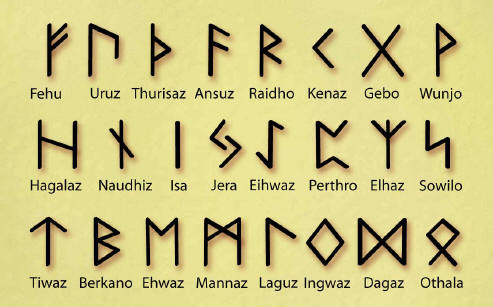
runesymbols

Have you ever wondered about the old-fashioned “ye” in shop signs?  It was a lazy printer’s solution to saving space for “th”, and should be pronounced as “the”, not “yee”!  The Old English character “y” was a graphic alteration of the Germanic rune “Þ” (which came over with the Viking raiders and the Norman King Canute and his rabble, but that’s another story).  When English printing typefaces couldn’t supply the right kind of “P” they substituted the “Y” (close enough, right?).  That practice continued into the 18th century, when it dropped out of use.  By the 19th century it was revived as a deliberate antiquarianism – to give a shop a pedigree, so to speak (read “marketing scam”), and soon came to be mocked because of it.  And now we think of it as the quaint way they used to write…

For a short, fun video on the topic, click on Ye Olde Web link, below.

ye-olde-web-link

7 Comments

Filed under History, Humor, Mistranslations, Nuts & Bolts, Translations

Anonymously Bad Grammar

The following sentences are taken verbatim from comments on unwitting websites; I’ve collected them as I’ve come across them since Autumn of 2013.  Sometimes I couldn’t help myself and put my comments in parentheses; other comments there are simply reference to the context.  I have dozens more, but certain things in life are better in small doses… Crap

  • “Don’t look like you like didn’t eat it all” (man, late-50s)
  • “I just havta buy some…” (woman, 18)
  • (Headline): “Welfare Check Leads to Homicide Investigation” (Referring to a response of officers to check on a suspicious situation, and not a monetary cheque…)
  • “I love London. Especially the countryside.” (face palm…not strictly bad grammar; just ignorance…)
  • “Now this statement I like – we are Ameica and our language is English – you want6 to live hear learn our language. And go by our rules.” (Concerning a sign that said, “Welcome to America. Press 1 for English; Press 2 to disconnect until you learn English.”  Clearly they missed grammar and spelling lessons.)
  • “Lively up yourself.”
  • “Who’s agree with us?”
  • “Sorry hand finger bad cut bleeding after topaz scared and did it. sorry it not up in the morning. Sorry sorting it I hope” (Whaaat??)
  • “I think it gonna b 2 these 4 me 2nite.” (Clearly.)
  • “That is the days I go shopping even if I don’t buy nothing hoping the family left at home do something.” (Hopefully the family is learning better grammar than this mother did…)

2 Comments

Filed under Humor, Lists, Nuts & Bolts, Quotes

Euphemisms

Euphemism 1Language is a fluid concept, constantly changing, adapting, creating, compensating and inventing itself.  Euphemisms are a prime example of that fluctuation and adaptation; successive generations come to know only the euphemism which in turn ceases to be one by that very definition, and which means that new ones will be invented to skirt the issue once again. For instance, there are hundreds of words for smell or stink, yet only a handful of satisfactory synonyms for words like fragrance, simply because hiding the ugly requires far more creativity than hiding the lovely.  For that reason alone, writers who fall back on expletives like the highly offensive F-word (a euphemism for, well, you know) are simply lazy in my book; they’re missing a great opportunity for creativity!  Interestingly, that word’s meaning has never shifted over time – it’s been in the English language since before the fifteenth century, and even then it was only written in cipher because it was too offensive to record in ink.  In my opinion it still is, and one should consider very carefully before offending unknown numbers of readers from continuing to read your book or blog; more than once have I ended reading a book when they used the word several times in the course of the first few chapters, because honestly it says something about the extent of their language abilities and their spectrum (or lack thereof) of creativity.

As a society’s norms shift, so do the euphemisms that they use to communicate.  In the Renaissance, corpulent women were considered the height of beauty; curvy, curvaceous, and shapely were instances of positive euphemisms; today they might be used by some idiot in the media to insult a Hollywood starlet who (by any other standard would be considered normal if not a little thin) gained a pound or two. Now idiot might be too strong a word; I could say brain cell-deficient, or someone who has delusions of adequacy.  I would like to point out the obvious here:  If you’re going to insult someone, at least spell it right… more often than not, you see people calling someone “dumn” or “dumm”, which smacks of the pot calling the kettle black…

For an interesting TED Talk (13:00) on the topic of euphemisms, please click here.

4 Comments

Filed under Articles, Cartoon, Etymology, Grammar, Nuts & Bolts, Writing Exercise

Toe the Line vs. Tow the Line

Toe the LineRecently I used the title’s idiom, and to be honest I don’t know if I’d ever used it before in writing; I’ve heard it said onk-times, but never had much use for it so far in written form.  Then came the question, is it “toe” or “tow”?  Actually the original phrase is nautical; but that could still be either spelling.  I did a bit of research, in both etymology dictionaries and a book of naval slang, online and in my library.  The consensus, I present here.

“Toe the line,”  according to Naval History & Heritage, comes from the practice of waterproofing between deck boards with a layer of oakum, pitch and tar, thus creating a striped deck; when the crew was ordered to fall in at quarters they would line up at their designated area of the deck, toes to the line to ensure a neat line for inspection.  Toeing the line was also used as a form of punishment for lighter misdemeanours aboard a ship, such as younger crew members talking at the wrong time; they were made to stand at the line for a specified amount of time to remind them to behave.  A logical leap later and we have our idiom, because the young lads were warned to “toe the line” – they were to mentally toe the line to avoid getting in trouble.

Tow the LineHowever, “Tow the line” could be seen as a malapropism, a mondegreen, or an eggcorn.  A malapropism (also called Dogberryism) is the substitution of an inappropriate word or expression in place of the correct and similarly-sounding word.  Example:  “Officer Dogberry said, “Our watch, sir, have indeed comprehended two auspicious persons” (apprehended two suspicious persons).  A mondegreen is an error arising from  understanding a spoken word or song text incorrectly.  Example:  “The ants are my friends, blowin’ in the wind” (the answer my friends) – Bob Dylan.  An eggcorn is an idiosyncratic (but semantically motivated) substitution of a word or phrase for a word or phrase that sound identical, or nearly so, at least in the dialect the speaker uses.  Example:  “for all intensive purposes” instead of “for all intents and purposes”.  Depending on your view of things, “tow the line could fall into any of those categories.  But it has so often been misused that it has begun to develop its own connotation independent of the original idiom:  While “toe the line” indicates a passive agreement or adherence to a particular regulation or ideology, “tow the line” implies more of an active participation in the enforcement or propagation of that “line” whether political, social, or business policy, as towing an object is not passive, but participative.

10 Comments

Filed under Articles, History, Mistranslations, Nuts & Bolts, Research

The Handshake of Character Development

business.gov.au, the Australian Government's dedicated business website1Have you ever stopped to consider the handshake?  It is a non-verbal form of communication, and it can tell you volumes about a person.  It is usually the first contact in a face-to-face transaction, used not only as a greeting form, but as an aid in assessing the other person’s confidence, assertiveness, aggression, or social skills.  What if the handshake is weak or strong, clammy or crushing?  Is it too short (which sends the signal that the person who breaks off the touch either disdains or disrespects the partner), or too long (which is an invasion of private space, too intimate, or disconcerting – it can even interrupt verbal exchange if it’s too awkward)?  Is it a neutral-valued exchange, or does the touch signify some ulterior motive (power-play, intimidation, invasion of the partner’s intimate sphere, a sexual connotation, etc.)?  What difference does it make for any of the above factors to take place between partners of the same sex vs. the opposite sex?  In other words, if two men shake hands and one is crushing, what message comes across differently if the partner being crushed is a woman?  Different cultural interpretations enter into the equation as well, as touch signifies various things in various cultures.  What difference is there to a handshake with a superior or authority figure to that of a peer or inferior?  What if the superior is a woman shaking the hand of a man of lower rank?  Or a woman of lower rank?  Or a man from a culture that does not recognize women as authority figures?

When developing a character for a novel, the handshake can be a telling gesture.  Even if none of the above questions are answered explicitly in your manuscript, just answering the questions for yourself can go a long way to your own understanding of the character, and how you want to express them to your readership.  So the next time you shake someone’s hand, alert your writer’s mind to take notes – putting those feelings into words develops your senses far more than simply identifying those feelings.  There have been a lot of studies on body language, particularly in the field of international business.  For a humorous yet telling video of the “Top Ten Bad Business Handshakes”, click on the image above.

Leave a comment

Filed under Articles, Nuts & Bolts, Plot Thots & Profiles, Research, Videos

Politeness Cultures

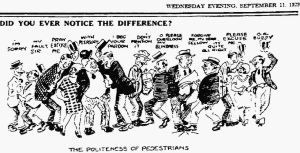
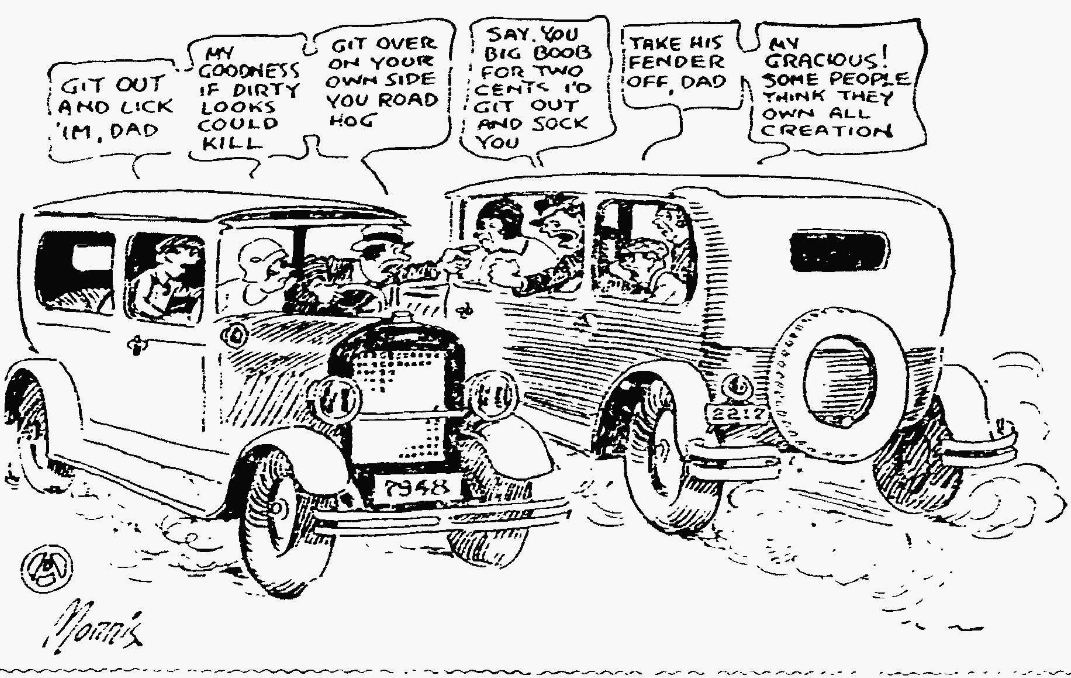
I recently came across a very interesting TED video addressing the differences between the American and British cultures on the specific aspect of politeness.  I grew up in the Midwest of America, emigrated to Scotland, lived in England for a while as well, and have friends scattered all over the “British Empire” & Commonwealth; I now live in Switzerland (adding several “Germanic” mentalities to my experience in that process!).  What the speaker (Lynne Murphy) observes makes a LOT of sense on both sides of the Puddle (Atlantic).  I share it with you because as a writer I know that those subtle, unspoken, unwritten differences in the ways people interact with each other and show their masks, or as Lynne calls them “faces”, make or break the authenticity in writing both prose and dialogue.  Click on the image below to watch the video; it’s 18 minutes long, so please watch it when you have time to focus! (By the way, the two cartoons below illustrate perfectly the difference between the “positive” face and the “negative” face.)

Politeness Politeness2

1 Comment

Filed under Articles, Cartoon, Images, Nuts & Bolts, Videos

Simply English, not Simple English

No VowelsThe following poem has been floating around for years; it’s so popular because it’s a great encapsulated example of the weirdness of English as a language!  It’s also a great exercise in stretching your vocabulary, being more aware of how to say words that are often only seen written and never heard pronounced.  And if you come across a word you don’t know, or could swear it’s pronounced differently than the rhyme of the poem indicates, I challenge you to look it up (Wiktionary is an example of a good source which shows how various dialects of English pronounce words if there is more than one option); and if you feel completely overwhelmed, click on the cartoon above to watch someone else chew their way through it!

Simply English

Dearest creature in creation,

Study English pronunciation.

I will teach you in my verse

Sounds like corpse, corps, horse, and worse.

I will keep you, Suzy, busy,

Make your head with heat grow dizzy.

Tear in eye, your dress will tear.

So shall I! Oh hear my prayer.

Just compare heart, beard, and heard,

Dies and diet, lord and word,

Sword and sward, retain and Britain.

(Mind the latter, how it’s written.)

Now I surely will not plague you

With such words as plaque and ague.

But be careful how you speak:

Say break and steak, but bleak and streak;

Cloven, oven, how and low,

Script, receipt, show, poem, and toe.

Hear me say, devoid of trickery,

Daughter, laughter, and Terpsichore,

Typhoid, measles, topsails, aisles,

Exiles, similes, and reviles;

Scholar, vicar, and cigar,

Solar, mica, war and far;

One, anemone, Balmoral,

Kitchen, lichen, laundry, laurel;

Gertrude, German, wind and mind,

Scene, Melpomene, mankind.

Billet does not rhyme with ballet,

Bouquet, wallet, mallet, chalet.

Blood and flood are not like food,

Nor is mould like should and would.

Viscous, viscount, load and broad,

Toward, to forward, to reward.

And your pronunciation’s OK

When you correctly say croquet,

Rounded, wounded, grieve and sieve,

Friend and fiend, alive and live.

Ivy, privy, famous; clamour

And enamour rhymes with hammer.

River, rival, tomb, bomb, comb,

Doll and roll and some and home.

Stranger does not rhyme with anger,

Neither does devour with clangour.

Souls but foul, haunt but aunt,

Font, front, wont, want, grand, and grant,

Shoes, goes, does. Now first say finger,

And then singer, ginger, linger,

Real, zeal, mauve, gauze, gouge and gauge,

Marriage, foliage, mirage, and age.

Query does not rhyme with very,

Nor does fury sound like bury.

Dost, lost, post and doth, cloth, loth.

Job, nob, bosom, transom, oath.

Though the differences seem little,

We say actual but victual.

Refer does not rhyme with deafer.

Foeffer does, and zephyr, heifer.

Mint, pint, senate and sedate;

Dull, bull, and George ate late.

Scenic, Arabic, Pacific,

Science, conscience, scientific.

Liberty, library, heave and heaven,

Rachel, ache, moustache, eleven.

We say hallowed, but allowed,

People, leopard, towed, but vowed.

Mark the differences, moreover,

Between mover, cover, clover;

Leeches, breeches, wise, precise,

Chalice, but police and lice;

Camel, constable, unstable,

Principle, disciple, label.

Petal, panel, and canal,

Wait, surprise, plait, promise, pal.

Worm and storm, chaise, chaos, chair,

Senator, spectator, mayor.

Tour, but our and succour, four.

Gas, alas, and Arkansas.

Sea, idea, Korea, area,

Psalm, Maria, but malaria.

Youth, south, southern, cleanse and clean.

Doctrine, turpentine, marine.

Compare alien with Italian,

Dandelion and battalion.

Sally with ally, yea, ye,

Eye, I, ay, aye, whey, and key.

Say aver, but ever, fever,

Neither, leisure, skein, deceiver.

Heron, granary, canary.

Crevice and device and aerie.

Face, but preface, not efface.

Phlegm, phlegmatic, ass, glass, bass.

Large, but target, gin, give, verging,

Ought, out, joust and scour, scourging.

Ear, but earn and wear and tear

Do not rhyme with here but ere.

Seven is right, but so is even,

Hyphen, roughen, nephew Stephen,

Monkey, donkey, Turk and jerk,

Ask, grasp, wasp, and cork and work.

Pronunciation — think of Psyche!

Is a paling stout and spikey?

Won’t it make you lose your wits,

Writing groats and saying grits?

It’s a dark abyss or tunnel:

Strewn with stones, stowed, solace, gunwale,

Islington and Isle of Wight,

Housewife, verdict and indict.

Finally, which rhymes with enough?

Though, through, plough, or dough, or cough?

Hiccough has the sound of cup.

My advice is give it up!


Leave a comment

Filed under Cartoon, Mistranslations, Nuts & Bolts, Quotes, Videos, Writing Exercise

One-Sentence Stories

One of the most challenging things as a writer is to remain succinct; “every word counts” needs to be printed on the back of my hands whether I’m working on a book manuscript, writing to a friend, or answering grammar questions on a forum I lead.  Occasional ramblings are far more acceptable than chronic ones; everyone has a friend, acquaintance or family member who rambles (or – you know who you are!):  I have a neighbour near our building who can turn the reply to a simple, “How are you?” into a 45-minute explanation of how her cousin’s frog’s nephew’s classmate’s teacher’s son’s uncle came by with a blue – or was it green?  You know the kind of green that looks like wilting grass, no, that’s too yellow… by the time she takes a breath she’s gone down so many detours I have NO idea what she’s talking about, or even what the original question was.  Needless to say, when I’m on a deadline I politely avoid that side of the house.

I’ve come across a website that would be a literal impossibility for that neighbour, and would even be a challenge for many of us who consider ourselves to personify the phrase, “brevity is the soul of wit”:  Click on the image below to see “One Sentence – True Stories Told in One Sentence”.  Take the challenge – can you write a story in one sentence?  And take inspiration from the site as well; there are some great starter-sentences there that could be expanded upon to make a short story, or even a novel.

Note:  Since this was originally posted, the site at the link below has gone offline.  Instead, just go to Google and search for “one-sentence stories“, and you’ll come across several great options.

That One Sentence

Leave a comment

Filed under Links to External Articles, Nuts & Bolts, Research, Writing Exercise

Airchaeology – If you Speak Scots

The internet is amazing.  You can find everything useful, useless, educational and brain-cell poisoning, all just a click away.  Just for the fun of it, when you really want to find out something about another culture’s mentality and way of looking at things, try Wikipedia in another language!  Click on the photo below to try it out in modern Scots.  And if you’re having trouble reading it, trying reading it aloud.

archaeology_header_img

Leave a comment

Filed under History, Nuts & Bolts, Research

How To Boost Your Focus

I’m probably the most organised person I know; I’m not OCD about it, I just work better when things are organised.  Writing a book means that I accumulate bits and pieces of information, research facts, website links, editing tips, formatting guidelines, historical trivia that I can integrate into my plot (but only if I can find it when I get there), maps, diagrams, lists of names in various languages, grammar points to remember (I’ve made up a word for “points to remember” – poitrems – you heard it here first), How-To cheat-sheets for PhotoShop, publication checklists (pre- and post-), Shelfari to-dos, and… need I continue?  I’m just getting started.  And that’s my point.  If I’m not organised, I’ll waste half my day looking for something… where did I put that note about the dimensions of a modern casket?  Was it hot arsenic or cyanide that smells like garlic?  Are blue diamonds more valuable than pure white?  What kind of micro-organism poops arsenic?  A friend of mine complimented me one day when I told her some of the things I was researching; she said, “You’re just weird.”  And it’s something my husband repeats fondly on a regular basis.

So, I’d like to share a few of my organisational tips with you:

1)  Know thyself.  Know your weaknesses (You know, those distractions, procrastination excuses, time-eating habits like “just checking into Facebook for a minute before I sit down to write” and an hour later you’re hungry, then you see that the kitchen needs cleaning… you know who you are.).  Recognize those time-wasters, and nip them in the bud before they mushroom into a day wasted.  Keep your cell phone at a safe distance; wear earplugs if you need to; turn on music if it helps you focus, turn it off if it distracts you.  Write down points to research and only dive into research when you have 5 items on the list (and stay away from time-monster sites like Facebook and Youtube while you’re working!)

Character Profile Worksheet 12)  Find a system that works for you.  I organise my notes, etc. in various ways:  I have pocket-sized Moleskin books for quick reference character profiles, lists of words, family trees of characters, etc.; I also have lined notebooks with those heavy-duty post-it tabs labelling the sections (that are well-spaced apart for future additions); I write the section names on the front and back of those tabs so that I can find it from either way the notebook lands on my desk.  For instance, one notebook I always have at hand has sections like publications, pre- & post- publication to-dos, paperback formatting checklist, KDP guidelines, CreateSpace guidelines, grammar, PhotoShop Elements helps, editing checklists, proofing checklists, Beta checklists, and step-by-step guides for various publication formats.  Another notebook I keep on hand has things like time-related notes (Julian calendar terms, Ages [Stone Age = ~6,000-2,000 BC], etc.), medical notes (that’s where I put that note about modern casket dimensions), glossaries for archaeological terms, 18th century England notes, lists of museum curators’ names, phone numbers and emails, etc.  Besides notebooks, I keep “cards” – here’s an example (to the right):  I type up the information in PowerPoint, then save each “card” to .jpg format through MS Paint.  These cards are then saved onto my Tab through Dropbox, and Bob’s your uncle, I’ve got them handy whether I’m writing on the couch, on holiday, or in a café.

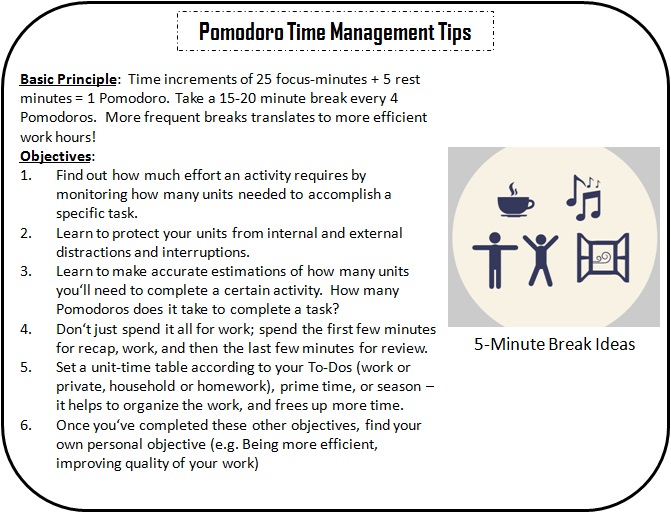
Pomodoro Time Management Tips3) Learn to focus.  I’ve recently found a great way to focus better through those hours of the day and night when I know I’m going to be most distracted:  It’s called Focus Booster.  It’s basically a timer on your desktop that counts down time increments, with an additional break-time at the end of each cycle.  The standard unit of time is 25/5, though you can adjust it to your rhythm.  The thinking is that anyone can focus on a given task for 25 minutes, even those who struggle with ADD.  In using it, I’ve realized how often I get distracted by a thought that comes into my mind while writing and I get up to do something quickly.  This way, I stay working for a solid amount of time, and use that 5 minutes to switch gears and get other things done; it’s amazing how much you can get accomplished in 30 minutes.  I’d encourage you to download it and give it a try if you struggle with concentration.  Here’s a second card I’ve made with the basic principles for the Booster.

Those are just a few ideas; if you struggle with a specific area, or would like suggestions on dealing with specific challenges in focusing, just ask away!  Focus well, and your writing will flow so much more smoothly and swiftly.


3 Comments

Filed under Articles, Nuts & Bolts, Research, Writing Exercise