Category Archives: Writing Exercise

Writing Tip: Layering

Lightning BugIf you’ve ever painted a picture more than a colouring book or a paint-by-number, chances are you’ve learned something along the way about layers.  Layering is also a digital graphics technique in programs such as Photoshop, and as each layer is made, the image changes, taking on the shapes or colours as you add the consecutive elements.

Besides being a writer, I am also a vocal coach.  I only take on students who are already in bands, or preparing for recordings or competitions, and one of the things I teach them is layering within a vocal performance:  The nuances of thoughts, the power of imagination, the colouring of the vocals through not only the physical placement of the tone within their instrument (their body), but the placement of their imagination.  One can communicate boredom or interest or empathy with the exact same wording by merely varying the intonation, and that comes through the layering of the performance.

Writing is much the same way:  It is through the employment of grammar, spelling and punctuation that we signal the reader to prepare for a particular experience; as Mark Twain said, “The difference between the right word and the almost right word is the difference between lightning and a lightning bug.”  

Oh, the difference between, “It was rainy last night,” and “It was a dark and stormy night”!

So the next time you feel like your manuscript or poem is falling flat, take a minute to think about the layers, and see what creative brush strokes you can give your work.

1 Comment

Filed under Articles, Nuts & Bolts, Plot Thots & Profiles, Writing Exercise

7 Steps to a Powerful Opening

bottle-opener - millennium-falcon-

A powerful opener…

Anyone who writes novels worth reading can tell you that, as with any relationship, the first impression you make is the most important.  You know that you need to get your character from A to Z through the story, but how you introduce A is more important than B through Z – in other words, if you lose your reader’s interest from the get-go, they might not stick around long enough to find out where you want to lead them.  Here are 7 steps to remember that will lead you to that great first impression:

  1. Dive in! Hit the ground running!  Begin your story in the middle of an action scene, or in the middle of a conversation.  Let your reader feel like they’re eavesdropping on a decisive moment in your character’s life.  Make them wonder, make them ask questions they want answers to!  Who’s speaking?  What’s the context?  Why is there X problem / challenge / discussion?
  2. Make your character human: Give them sympathetic traits, a relatable nature, and attitudes that readers can identify with.  Do this through dialogue and actions, or by internalization (getting inside the character’s head, an “inner dialogue”).  It will help you to prepare your main characters by writing out a biography for them.  Give them memorable names (not complicated ones, or names that are difficult to work out how to pronounce).  The main character must be somewhat larger than life (more interesting than the average person in some way); do this through giving them idiosyncrasies, habits, a quirky sense of humour, etc.
  3. Romance: If your character is real, there will be romance – some kind of heart-to-heart relationship that touches that key human emotion.  I’m not talking about slutty romance novels; I’m talking about real human connection and rich emotional landscapes, whether it’s a small-town story, a science fiction planet, or a war zone.
  4. Supporting character: This might be a sidekick, a friend, partner, companion, or even an object or pet.  It is someone or something for the main character to share their experiences with.  The supporting character should contrast your main character – perhaps someone who asks the reader’s questions, or wants explanation of terms or concepts the reader might not be familiar with, without becoming “teach-y”.  They might be the voice of reason to an impulsive main character, or the voice of adventure to a staid hero/heroine.
  5. Antagonist: This opponent is an obstruction to the main character’s goals.  They create problems, sometimes danger.  They may be human, or non-human (e.g. man vs. nature), or may be an internal struggle of the main character (haunted by their past, or an addiction, a weakness such as impatience, etc.).
  6. Emotion: Build an emotional landscape (this links closely with # 3).  Show the main character as life-like, and develop relationships, or show struggles the character has with particular issues that give them depth and breadth.
  7. Style: Bring it all together in a style unique to your character’s voice and biography.  Show their feelings, conflicts, adding complications and subplots to take it deeper.  In your first chapter the goal of your character should come out – what their desires are, their determination, problems to solve, etc. – without making the arrival at that goal all too obvious!

6 Comments

Filed under Lists, Plot Thots & Profiles, Writing Exercise

Novel Writing Pyramid

Novel Pyramid

When writing or drafting a new story, sometimes it’s easy to get lost in the forest due to the trees – in the myriad of ideas that flash up in a brainstorm.  The pyramid above helps remind me of the emphasis each area needs in the overall structure:

If a story is too complex, you’ll lose or confuse your readers; but if it’s too simple, it becomes predictable and therefore no challenge to the mind of the adventurer who’s picked up your book to get lost in another world.  Most of the best stories are, at their heart, quite simple – “boy meets girl”, or “person achieves goal”.

If you don’t know what your settings and themes are, how can you effectively work toward the final outcome?  If you don’t know who your character is, and what your basic plot (goal and how it’s achieved) is, how can you guide the reader through dialogue or prose toward the desired conclusion?  Diction is important because it is central to creating the voice of each character, and sticking to genre-specific vocabulary and expressions (i.e. no proverbial airplanes through the scenes of a historical novel).  As Mark Twain once wrote,

“The difference between the right word and the almost-right word is the difference between lightning and a lightning bug.”

And if you have the top four slices of the pyramid in place, but don’t have proper foundations – in other words, know your grammar, spelling, punctuation and syntax (sentence structures, tense usage, etc.) then no matter how brilliant your plot might be, or your character development, if readers can’t get past your bad diction and grammar, you’ve lost them as present and future readers!

I’d like to encourage you to know your weaknesses, and develop them into strengths!  If grammar or spelling is a weakness, work on it – invest time into reviewing the rules – Wikipedia is an excellent source for articles on how to use punctuation, etc.  Buy a good grammar book, or even a grammar practice book with an answer key at the back (The “English Grammar in Use” series is one I used for years with EFLA students).  If plot or character development is a weakness, then make a list of questions for each, and take the time to think about and answer them.

Good writing is about quality; it’s about solid foundations and constant development, the honing of your skills; it’s about research, thinking outside the box, and being able to convey in words the images born in your mind.  Just as sharpening a pencil makes it easier to write, so does sharpening your mind and skills.

1 Comment

Filed under Articles, Images, Nuts & Bolts, Plot Thots & Profiles, Research, Writing Exercise

Creative Writing over Christmas Holidays

I don’t know about the rest of you, but Christmas has snuck up on me this year!  Between publishing two books in November and all of the work involved in that process and the aftermath (promotion, etc.), I came up for breath last weekend, as I wrote about last week.  I took a short break, and now I’m beginning work on the next project (diving into research and scene layout).  But with Christmas coming up, it’s time to shift down a gear or two, and enjoy the season.  If you are a writer like me, writing can be addictive; it’s a good habit to write something every day.  But who says it needs to be a book manuscript, or whatever your next project or usual format is?  If you write poetry, try your hand at calligrams; if you write short stories, try writing an ambigram.  If you write constantly, take a break and read a book that has absolutely nothing to do with research or preparation for your next project!

Here are a few different styles to choose from, just to shake things up a bit:

  • Flash fiction (300-1,000 – word stories)

    One of my first calligrams; not very neat, but cathartic!

    One of my first calligrams; not very neat, but cathartic!

  • Short stories (fiction or nonfiction – limit yourself, e.g. to one page)
  • Nonfiction
  • Anecdotes
  • Jokes
  • Profiles
  • Travel writing
  • Children’s books
  • Screen writing
  • Play writing
  • Poetry
  • Freelance
  • Novel
  • Novella
  • Memoir
  • Autobiography
  • Biography
  • Song writing (lyrics, if you can’t write/read music)
  • Calligram (do a Google Image search to see examples)
  • Asemic writing
  • Book report
  • Fan fiction
  • Letter
  • Journal
  • Dialogue
  • Creative doodles (with or without words)
  • Cartoon strips
  • Ambigram
  • Micography (Microcalligraphy)
  • Concrete poetry (or any number of poetry styles – check out a small list here)
  • Haiku


2 Comments

Filed under Images, Lists, Nuts & Bolts, Writing Exercise

20 Writing Sparks

Creative WritingOnce in a while, we need to get our creative juices flowing; here are some ideas to spark your imagination!  Pick one, get a pen and paper, and start writing!  See where it leads!

20 Writing Sparks

1. What is it that you are absolutely sure you will never forget?

2. doorbell rings

3. perfect family

4. zombie packing list

5. flight vs. invisibility

6. two animals into one hybrid

7. Describe each day of the week as if it was a person.

8. you fly but you lose a minute every time

9. design and describe the perfect bedroom

10. library, museum, zoo

11. which friend will become the most famous?

12. you give a personal concert

13. complain about kids these days

14. glow in the dark tattoo

15. magical mailbox

16. I deserve a day off school

17. average of five people

18. celebrity, famous person, character as sibling

19. describe daily life in 2045

20. honesty room

2 Comments

Filed under Lists, Writing Exercise

Euphemisms

Euphemism 1Language is a fluid concept, constantly changing, adapting, creating, compensating and inventing itself.  Euphemisms are a prime example of that fluctuation and adaptation; successive generations come to know only the euphemism which in turn ceases to be one by that very definition, and which means that new ones will be invented to skirt the issue once again. For instance, there are hundreds of words for smell or stink, yet only a handful of satisfactory synonyms for words like fragrance, simply because hiding the ugly requires far more creativity than hiding the lovely.  For that reason alone, writers who fall back on expletives like the highly offensive F-word (a euphemism for, well, you know) are simply lazy in my book; they’re missing a great opportunity for creativity!  Interestingly, that word’s meaning has never shifted over time – it’s been in the English language since before the fifteenth century, and even then it was only written in cipher because it was too offensive to record in ink.  In my opinion it still is, and one should consider very carefully before offending unknown numbers of readers from continuing to read your book or blog; more than once have I ended reading a book when they used the word several times in the course of the first few chapters, because honestly it says something about the extent of their language abilities and their spectrum (or lack thereof) of creativity.

As a society’s norms shift, so do the euphemisms that they use to communicate.  In the Renaissance, corpulent women were considered the height of beauty; curvy, curvaceous, and shapely were instances of positive euphemisms; today they might be used by some idiot in the media to insult a Hollywood starlet who (by any other standard would be considered normal if not a little thin) gained a pound or two. Now idiot might be too strong a word; I could say brain cell-deficient, or someone who has delusions of adequacy.  I would like to point out the obvious here:  If you’re going to insult someone, at least spell it right… more often than not, you see people calling someone “dumn” or “dumm”, which smacks of the pot calling the kettle black…

For an interesting TED Talk (13:00) on the topic of euphemisms, please click here.

4 Comments

Filed under Articles, Cartoon, Etymology, Grammar, Nuts & Bolts, Writing Exercise

The Art of Listening

ListeningAs a writer I’m constantly on the lookout for ways to improve any of my skills, be they technical, linguistic, goal-oriented (such as the skills it takes to publish a book), or basic.  Listening falls into the latter category; it’s something all of us do, yet all of us can improve on.  I don’t think I need to mention the fact that we are a generation on information overload; media screams at us to get our attention, whether through the use of power-punching, gut-wrenching headlines, or power-words written in ALL CAPS! with the appropriate punctuation, or flashing ads that give us no peace until we either turn them off or leave the website they’ve invaded.  Adds flash at us constantly whether on TV, in shops, on the internet, or driving down the motorway.  Eventually we become numb and stop listening.  We put in our ear-buds, turn on a song of our choice and try to tune out the rest of the world, at least for a moment.

By improving listening, I am not implying that we toss out our MP3 players and force ourselves to listen to everything in case we miss something important.  We must all use discretion about where our “focus energy” goes.  But by improving our listening, we can begin to hear the quieter, more subtle elements; we can focus our ears and minds to perceive things that might be more worthwhile than the noise that vies for our attention.  Conscious listening creates understanding.

I recently listened to a TED talk by Julian Treasure on five exercises to improve listening; I share them with you here; click on the image above if you’d like to watch the talk yourself:

1)  Silence:  For at least three minutes a day, try to find a place of complete silence (if not possible, at least aim for very quiet).  It helps to recalibrate your ears, so that you can actually hear the quieter things once again.

2) Mixer:  In a noisy environment, whether a café or sitting by a stream, practice focusing your ears on one sound, then another;  It will improve the quality of your listening.  I use this technique with singing students; before they begin rehearsing with a song we will analyse and dissect it instrument by instrument, verse by verse, vocal by vocal.  The more they become aware of this process, the better they will understand how their vocals fit into the bigger picture as both a wind- and stringed instrument.

3)  Savouring:  There’s a “hidden choir” all around you; focusing on such mundane sounds as the dish washer or the coffee machine can reveal rhythms and build an appreciation of the simpler things in life.  Sound technicians for films use this as their greatest tool; because they’ve trained themselves in this area, they know they can combine the squishing of an orange, the grating of a cinder block across a corrugated iron sheet and the distortion of their vacuum cleaner’s sound to come up with a monster ala the Balrog of Lord of the Rings, or scraping keys along a piano wire to land Dr. Who’s TARDIS.

4)  Listening Positions:  This is the idea that you can shift your position (“level” of listening) according to what you’re listening to:  active/passive, reductive/expansive, critical/empathetic.  These adjust certain filters that we all have, such as culture, language, values, beliefs, attitudes, expectations and intentions, which increasingly focus our listening from all “sounds” down to things we specifically listen to.

5) RASA:  An acronym for Receive (i.e. paying attention to the person), Appreciate (giving verbal feedback such as small sounds of agreement or interest), Summarize (feedback of what you’ve understood), and Ask (ask questions afterward).  Practicing RASA will improve not only how we listen, but our retention of information.

Listening is one of our five senses, and one that’s worth exploring in writing; when a reader can become absorbed in the sensations of a scene – hearing, smelling, seeing, feeling and tasting the environment through well-chosen words – they will be invested in the story, and care about what happens next.

Leave a comment

Filed under Articles, Videos, Writing Exercise

Simply English, not Simple English

No VowelsThe following poem has been floating around for years; it’s so popular because it’s a great encapsulated example of the weirdness of English as a language!  It’s also a great exercise in stretching your vocabulary, being more aware of how to say words that are often only seen written and never heard pronounced.  And if you come across a word you don’t know, or could swear it’s pronounced differently than the rhyme of the poem indicates, I challenge you to look it up (Wiktionary is an example of a good source which shows how various dialects of English pronounce words if there is more than one option); and if you feel completely overwhelmed, click on the cartoon above to watch someone else chew their way through it!

Simply English

Dearest creature in creation,

Study English pronunciation.

I will teach you in my verse

Sounds like corpse, corps, horse, and worse.

I will keep you, Suzy, busy,

Make your head with heat grow dizzy.

Tear in eye, your dress will tear.

So shall I! Oh hear my prayer.

Just compare heart, beard, and heard,

Dies and diet, lord and word,

Sword and sward, retain and Britain.

(Mind the latter, how it’s written.)

Now I surely will not plague you

With such words as plaque and ague.

But be careful how you speak:

Say break and steak, but bleak and streak;

Cloven, oven, how and low,

Script, receipt, show, poem, and toe.

Hear me say, devoid of trickery,

Daughter, laughter, and Terpsichore,

Typhoid, measles, topsails, aisles,

Exiles, similes, and reviles;

Scholar, vicar, and cigar,

Solar, mica, war and far;

One, anemone, Balmoral,

Kitchen, lichen, laundry, laurel;

Gertrude, German, wind and mind,

Scene, Melpomene, mankind.

Billet does not rhyme with ballet,

Bouquet, wallet, mallet, chalet.

Blood and flood are not like food,

Nor is mould like should and would.

Viscous, viscount, load and broad,

Toward, to forward, to reward.

And your pronunciation’s OK

When you correctly say croquet,

Rounded, wounded, grieve and sieve,

Friend and fiend, alive and live.

Ivy, privy, famous; clamour

And enamour rhymes with hammer.

River, rival, tomb, bomb, comb,

Doll and roll and some and home.

Stranger does not rhyme with anger,

Neither does devour with clangour.

Souls but foul, haunt but aunt,

Font, front, wont, want, grand, and grant,

Shoes, goes, does. Now first say finger,

And then singer, ginger, linger,

Real, zeal, mauve, gauze, gouge and gauge,

Marriage, foliage, mirage, and age.

Query does not rhyme with very,

Nor does fury sound like bury.

Dost, lost, post and doth, cloth, loth.

Job, nob, bosom, transom, oath.

Though the differences seem little,

We say actual but victual.

Refer does not rhyme with deafer.

Foeffer does, and zephyr, heifer.

Mint, pint, senate and sedate;

Dull, bull, and George ate late.

Scenic, Arabic, Pacific,

Science, conscience, scientific.

Liberty, library, heave and heaven,

Rachel, ache, moustache, eleven.

We say hallowed, but allowed,

People, leopard, towed, but vowed.

Mark the differences, moreover,

Between mover, cover, clover;

Leeches, breeches, wise, precise,

Chalice, but police and lice;

Camel, constable, unstable,

Principle, disciple, label.

Petal, panel, and canal,

Wait, surprise, plait, promise, pal.

Worm and storm, chaise, chaos, chair,

Senator, spectator, mayor.

Tour, but our and succour, four.

Gas, alas, and Arkansas.

Sea, idea, Korea, area,

Psalm, Maria, but malaria.

Youth, south, southern, cleanse and clean.

Doctrine, turpentine, marine.

Compare alien with Italian,

Dandelion and battalion.

Sally with ally, yea, ye,

Eye, I, ay, aye, whey, and key.

Say aver, but ever, fever,

Neither, leisure, skein, deceiver.

Heron, granary, canary.

Crevice and device and aerie.

Face, but preface, not efface.

Phlegm, phlegmatic, ass, glass, bass.

Large, but target, gin, give, verging,

Ought, out, joust and scour, scourging.

Ear, but earn and wear and tear

Do not rhyme with here but ere.

Seven is right, but so is even,

Hyphen, roughen, nephew Stephen,

Monkey, donkey, Turk and jerk,

Ask, grasp, wasp, and cork and work.

Pronunciation — think of Psyche!

Is a paling stout and spikey?

Won’t it make you lose your wits,

Writing groats and saying grits?

It’s a dark abyss or tunnel:

Strewn with stones, stowed, solace, gunwale,

Islington and Isle of Wight,

Housewife, verdict and indict.

Finally, which rhymes with enough?

Though, through, plough, or dough, or cough?

Hiccough has the sound of cup.

My advice is give it up!


Leave a comment

Filed under Cartoon, Mistranslations, Nuts & Bolts, Quotes, Videos, Writing Exercise

One-Sentence Stories

One of the most challenging things as a writer is to remain succinct; “every word counts” needs to be printed on the back of my hands whether I’m working on a book manuscript, writing to a friend, or answering grammar questions on a forum I lead.  Occasional ramblings are far more acceptable than chronic ones; everyone has a friend, acquaintance or family member who rambles (or – you know who you are!):  I have a neighbour near our building who can turn the reply to a simple, “How are you?” into a 45-minute explanation of how her cousin’s frog’s nephew’s classmate’s teacher’s son’s uncle came by with a blue – or was it green?  You know the kind of green that looks like wilting grass, no, that’s too yellow… by the time she takes a breath she’s gone down so many detours I have NO idea what she’s talking about, or even what the original question was.  Needless to say, when I’m on a deadline I politely avoid that side of the house.

I’ve come across a website that would be a literal impossibility for that neighbour, and would even be a challenge for many of us who consider ourselves to personify the phrase, “brevity is the soul of wit”:  Click on the image below to see “One Sentence – True Stories Told in One Sentence”.  Take the challenge – can you write a story in one sentence?  And take inspiration from the site as well; there are some great starter-sentences there that could be expanded upon to make a short story, or even a novel.

Note:  Since this was originally posted, the site at the link below has gone offline.  Instead, just go to Google and search for “one-sentence stories“, and you’ll come across several great options.

That One Sentence

Leave a comment

Filed under Links to External Articles, Nuts & Bolts, Research, Writing Exercise

How To Boost Your Focus

I’m probably the most organised person I know; I’m not OCD about it, I just work better when things are organised.  Writing a book means that I accumulate bits and pieces of information, research facts, website links, editing tips, formatting guidelines, historical trivia that I can integrate into my plot (but only if I can find it when I get there), maps, diagrams, lists of names in various languages, grammar points to remember (I’ve made up a word for “points to remember” – poitrems – you heard it here first), How-To cheat-sheets for PhotoShop, publication checklists (pre- and post-), Shelfari to-dos, and… need I continue?  I’m just getting started.  And that’s my point.  If I’m not organised, I’ll waste half my day looking for something… where did I put that note about the dimensions of a modern casket?  Was it hot arsenic or cyanide that smells like garlic?  Are blue diamonds more valuable than pure white?  What kind of micro-organism poops arsenic?  A friend of mine complimented me one day when I told her some of the things I was researching; she said, “You’re just weird.”  And it’s something my husband repeats fondly on a regular basis.

So, I’d like to share a few of my organisational tips with you:

1)  Know thyself.  Know your weaknesses (You know, those distractions, procrastination excuses, time-eating habits like “just checking into Facebook for a minute before I sit down to write” and an hour later you’re hungry, then you see that the kitchen needs cleaning… you know who you are.).  Recognize those time-wasters, and nip them in the bud before they mushroom into a day wasted.  Keep your cell phone at a safe distance; wear earplugs if you need to; turn on music if it helps you focus, turn it off if it distracts you.  Write down points to research and only dive into research when you have 5 items on the list (and stay away from time-monster sites like Facebook and Youtube while you’re working!)

Character Profile Worksheet 12)  Find a system that works for you.  I organise my notes, etc. in various ways:  I have pocket-sized Moleskin books for quick reference character profiles, lists of words, family trees of characters, etc.; I also have lined notebooks with those heavy-duty post-it tabs labelling the sections (that are well-spaced apart for future additions); I write the section names on the front and back of those tabs so that I can find it from either way the notebook lands on my desk.  For instance, one notebook I always have at hand has sections like publications, pre- & post- publication to-dos, paperback formatting checklist, KDP guidelines, CreateSpace guidelines, grammar, PhotoShop Elements helps, editing checklists, proofing checklists, Beta checklists, and step-by-step guides for various publication formats.  Another notebook I keep on hand has things like time-related notes (Julian calendar terms, Ages [Stone Age = ~6,000-2,000 BC], etc.), medical notes (that’s where I put that note about modern casket dimensions), glossaries for archaeological terms, 18th century England notes, lists of museum curators’ names, phone numbers and emails, etc.  Besides notebooks, I keep “cards” – here’s an example (to the right):  I type up the information in PowerPoint, then save each “card” to .jpg format through MS Paint.  These cards are then saved onto my Tab through Dropbox, and Bob’s your uncle, I’ve got them handy whether I’m writing on the couch, on holiday, or in a café.

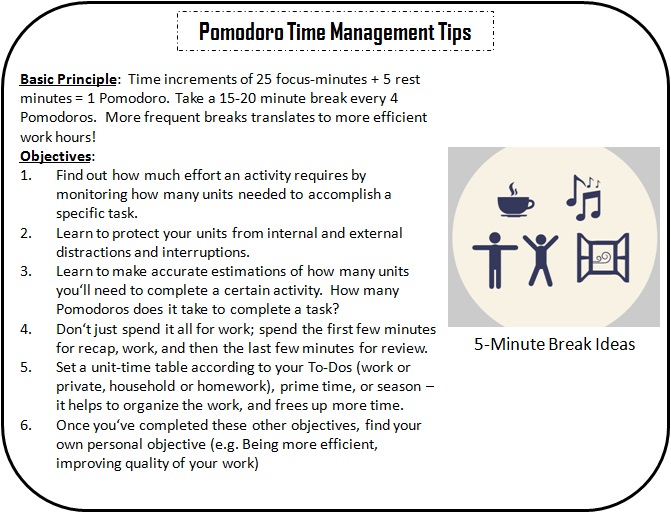
Pomodoro Time Management Tips3) Learn to focus.  I’ve recently found a great way to focus better through those hours of the day and night when I know I’m going to be most distracted:  It’s called Focus Booster.  It’s basically a timer on your desktop that counts down time increments, with an additional break-time at the end of each cycle.  The standard unit of time is 25/5, though you can adjust it to your rhythm.  The thinking is that anyone can focus on a given task for 25 minutes, even those who struggle with ADD.  In using it, I’ve realized how often I get distracted by a thought that comes into my mind while writing and I get up to do something quickly.  This way, I stay working for a solid amount of time, and use that 5 minutes to switch gears and get other things done; it’s amazing how much you can get accomplished in 30 minutes.  I’d encourage you to download it and give it a try if you struggle with concentration.  Here’s a second card I’ve made with the basic principles for the Booster.

Those are just a few ideas; if you struggle with a specific area, or would like suggestions on dealing with specific challenges in focusing, just ask away!  Focus well, and your writing will flow so much more smoothly and swiftly.


3 Comments

Filed under Articles, Nuts & Bolts, Research, Writing Exercise