Category Archives: Images

Odd Jobs #3: Bereavement Coordinator to Car Plate Blockers

JAPAN-ART-PAINTING

Body Painter.  Photo credit: YOSHIKAZU TSUNO/AFP/Getty Images

For most of the odd jobs in this week’s lineup, I was able to find a link with a description of some kind; but, not surprisingly, “one of these is not like the others” (a Sesame Street throwback…) – the only illegal job of them all; it seems to have found a niche market in a black market sense of the word.  In a weird way, it reminds me of “lines of desire” – where there’s a will, there’s a way.

I find it interesting to include “Blacksmith” in this list; what was once a trade found in any town worth its salt, and testified to by the number of people with the surname Smith, is now a rarity.

By the way, I’m running a similar series on my history blog under the heading “Odd Jobs of Bygone Days” in case you’re interested.

6 Comments

Filed under Articles, Images, Lists, Research

Just for Fun #3: Vegetarian

Vegetarian, Bad Hunter

3 Comments

May 11, 2016 · 9:44 PM

Lost in Translation: Pepsi

In 1963, Pepsi launched the “Come Alive!  You’re in the Pepsi Generation!” campaign.  All well and good until they took it to China, where the slogan translated as “Pepsi – Bring Your Ancestors Back from the Dead”.

Needless to say, it was a short-lived campaign, despite its claim to resurrect Grandpa.

LIT - Pepsi, Come Alive with the Pepsi Generation, 1963


LIT - Pepsi, Chinese of Come Alive with the Pepsi Generation, 1963

5 Comments

Filed under Humor, Images, Mistranslations, Signs

Lost in Translation: Bird Crap

I don’t know if this would really qualify as being “lost in translation” as it is the original English name of the product, and it is intentional; it may just fall under the category of marketing flops or faux pas.  But either way, the last thing I want going through my mind as I take a bite of a nicely grilled burger is this brand name…

LIT - Bird Crap Seasoning

Here’s a close-up of the label:

LIT - Bird Crap Seasoning Label

Ya never know – it might sell quite well, just as a marketing gag (no pun intended – well, maybe it was)…

6 Comments

Filed under Humor, Images, Mistranslations

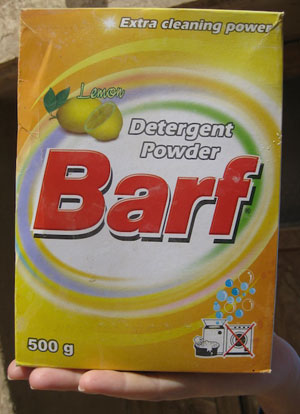
Lost in Translation: Barf

In Iran, where this laundry detergent is produced, the name means “snow”.  For obvious reasons I don’t think they should try to break into the English market…

In Iran, where this detergent is manufactured, that word means -snow

For other ads lost in translation, click here.

4 Comments

Filed under Humor, Images, Mistranslations, Signs

One Fine Day in the Middle of the Night

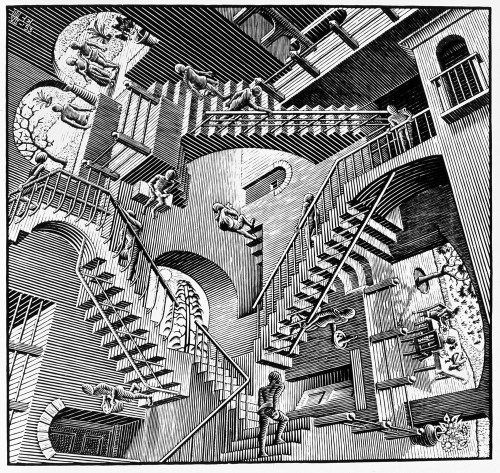
Escher-relativity 2Back before I was married, I lived in Paisley (Scotland) with an English roommate; we got along like clotted cream and jam, and, among other things, we would recite the following verse in sync any time we heard someone say,  “I see”.  There are longer, more elaborate versions that have been around for over 50 years.  The mutations make it hard to trace it to the original source, as it seems that each person, school class or generation tweaks it with their own twist.

One Fine Day

“I see,” said the blind man to the deaf man

One fine day in the middle of the night,

Two dead men got up to fight;

Back to back they faced each other,

Drew their swords and shot each other.

A deaf policeman heard the noise,

And came and shot those two dead boys.

If you don’t believe my tale is true,

Ask the blind man, he saw it too.

Do you have any favourite rhymes, verses or ditties that you’ve known for years?

Please share them in the comments below!

Illustration:  “Relativity”, by M.C. Escher

28 Comments

Filed under Humor, Images, Poetry

Just Sayin’

I had to share this!  As Mark Twain once said, “The difference between the right word and the almost right word is the difference between lightning and a lightning bug.”  In this case, it’s the difference between a home run and a strike…

Right Word


3 Comments

Filed under Humor, Images, Quotes

Knowing Jack Schitt

This piece of writing has been floating around cyberspace for quite some time; I’ve tried to track down just who is responsible for it, with no luck [Note, November 2024: It was written by Jim Hickerson, as a fun email among co-workers back in 1998. See links to explanation and to the credits page].  It’s so tongue-in-cheek, your tongue may permanently stay there, and I dare you not to think of the whole family tree the next time you hear any of the associated phrases!

Who is Jack Schitt?

The lineage is finally revealed. Many people are at a loss for a response when someone says “You don’t know Jack Schitt.” Now you can intellectually handle the situation.

Jack is the son of Awe Schitt and O. Schitt. Awe Schitt, the fertilizer magnate, married O. Schitt, the owner of Needeep N. Schitt Inc. They had one son, Jack. In turn Jack Schitt married Noe Schitt, the deeply religious couple produced six children: Holie Schitt, Fulla Schitt, Giva Schitt, Bull Schitt, and the twins: Deap Schitt and Dip Schitt. Against her parents’ objections, Deap Schitt married Dumb Schitt, a high school drop out.

However, after being married 15 years, Jack and Noe Schitt divorced. Noe Schitt later remarried Ted Sherlock and, because her kids were living with them, she wanted to keep her previous name.

She was then known as Noe Schitt-Sherlock. Meanwhile, Dip Schitt married Loda Schitt and they produced a son of nervous disposition, Chicken Schitt. Two other of the six children, Fulla Schitt and Giva Schitt, were inseparable throughout childhood and subsequently married the Happens brothers in a dual ceremony.

The wedding announcement in the newspaper announced the Schitt-Happens wedding. The Schitt-Happens children were Dawg, Byrd, and Hoarse. Bull Schitt, the prodigal son, left home to tour the world. He recently returned from Italy with his new Italian bride, Pisa Schitt.  She’d had a pet dog, a mastiff who was known in the region by his Chinese name, Ho Le Schitt, because he ate small gangsters for breakfast; she couldn’t afford to feed him in her new country, so she left him where his food supply would not run out.

So now when someone says, “You don’t know Jack Schitt,” you can correct them.

Image Credit: Nobleworkscards.com

O. Schitt – this tree doesn’t quite match the lineage above. O. Well. Image Credit: Nobleworkscards.com

17 Comments

Filed under Humor, Images

SWOT Analysis in Fiction

Writing fiction often brings the writer to a crossroads:  Should I take my character(s) down this road or that?  Will they decide this or that, and what will the consequences of either choice or decision be?  Which would fit best into my plot?  All of these questions can be answered by applying a corporate business tool called the SWOT analysis chart.  I have this baby hung on a magnet strip near my desk, along with other prompts such as the sensory image, and I apply it frequently.  Just last week I faced a crossroads:  Would A) my character run away, or would B) another character (or C) take her away?  On the latter question, I had another two options (thus, B & C); I needed the SWOT.

SWOT Analysis Chart, Watermark

This image shows you the variables of each option; internal vs. external influences or attributes of a situation or choice; helpful vs. harmful in reaching the character’s goals, or the consequences of the choices laid before you.  What are the Strengths, Weaknesses, Opportunities and Threats of each path at your character’s feet?

I’ll give you the example of my thought process as I applied it to my historical novel’s fictional situation:  If my character ran away (A) , the strength would be that she would be taking her destiny into her own hands – it’s what you want your main character to do; the threat would be that such an action might raise assumptions that would damage her reputation (was she pregnant?).  The opportunity of doing things in her own timing was overshadowed by the weakness of practicalities:  How would she, without support, get from her family’s estate to Portsmouth, at least a good half-day’s journey by carriage?  If the “B” character (her mother) took her to Portsmouth, the main character would be passive in the decision – the action would happen to her rather than her controlling or causing it.  The opportunity of solving the weakness of “A” by giving her a ride to Portsmouth was a strong incentive, but would raise a bigger threat in that it might seem like the mother was being just as manipulative as the father, forcing the main character into making a choice to suit the mother, which wasn’t the case.  If “C”, her future husband, came to sweep her away from the problems at home, again it would seem that the main female character wasn’t strong on her own two feet, or was too pliable and passive.

I took each scenario through the SWOT rigorously, and in the end I decided – well, when the book comes out next year, you can find out for yourself!

Applying such tools helps you focus your energies on finding solutions, rather than finding yourself stuck in writer’s block.

6 Comments

Filed under Articles, Images, Nuts & Bolts, Plot Thots & Profiles, Research, Writing Exercise

Truth into Fiction

Sometimes truth is more fascinating, more adventurous than fiction.  Sometimes a news article becomes a spark for a fictional story.  One of the greatest films of all time, Titanic, took its cue from real life; many books and films are based on real life stories, mysteries, narrow escapes, historical events and experiences.  The best kinds of story sparks are those things which capture our imagination; not only best for the reader, but also for the writer – for if you are not excited by and captivated by what you’re writing about, researching and investigating, how do you expect a reader to be excited or captivated by it?  Personally, history has always fascinated me; I wonder, “What would it be like to walk among them?” or “What would it be like to discover these events as a modern archaeologist?”  I explored such a theme in my novels, “The Cardinal“.

Here are a few historical sparks that might capture your imagination; just click on  each image to link to the article:

Artifacts from the Battle of the Egadi Islands, ca. 240 BC

Battle of the Egadi Islands, 241 BC

The City of Heracleion, Plunged into the Sea

Heracleion Artifacts

China’s Atlantis:  Shi Cheng

China's Atlantis of the East, Shi Cheng

The Skulls of  Sac Uayum

The Elongated Skulls of the Yucatan underwater cave, Sac Uayum

An Ancient Roman Shipwreck Reveals Medicinal Remedies

Roman Shipwreck with Medicinal Supplies

2 Comments

Filed under History, Images, Lists, Nuts & Bolts, Plot Thots & Profiles, Research, Writing Exercise